WebRTC vs. SIP: Understanding the Differences & Use Cases
The New Kid on the Block
I often get asked: "Should we use SIP or WebRTC?" The answer is usually "Both".
SIP (Session Initiation Protocol) is a signaling protocol. It tells the network "I want to call Bob". It doesn't carry audio itself.
WebRTC (Web Real-Time Communication) is a set of browser standards that handle the media (audio/video) and the encryption layer directly in Chrome/Firefox/Safari.
Key Difference: The Transport
- SIP usually runs over UDP or TCP on port 5060. It's lightweight and compatible with hardware phones.
- WebRTC mandates secure encryption (DTLS-SRTP) and typically uses a WebSocket for signaling (since browsers can't do raw TCP/UDP sockets easily).
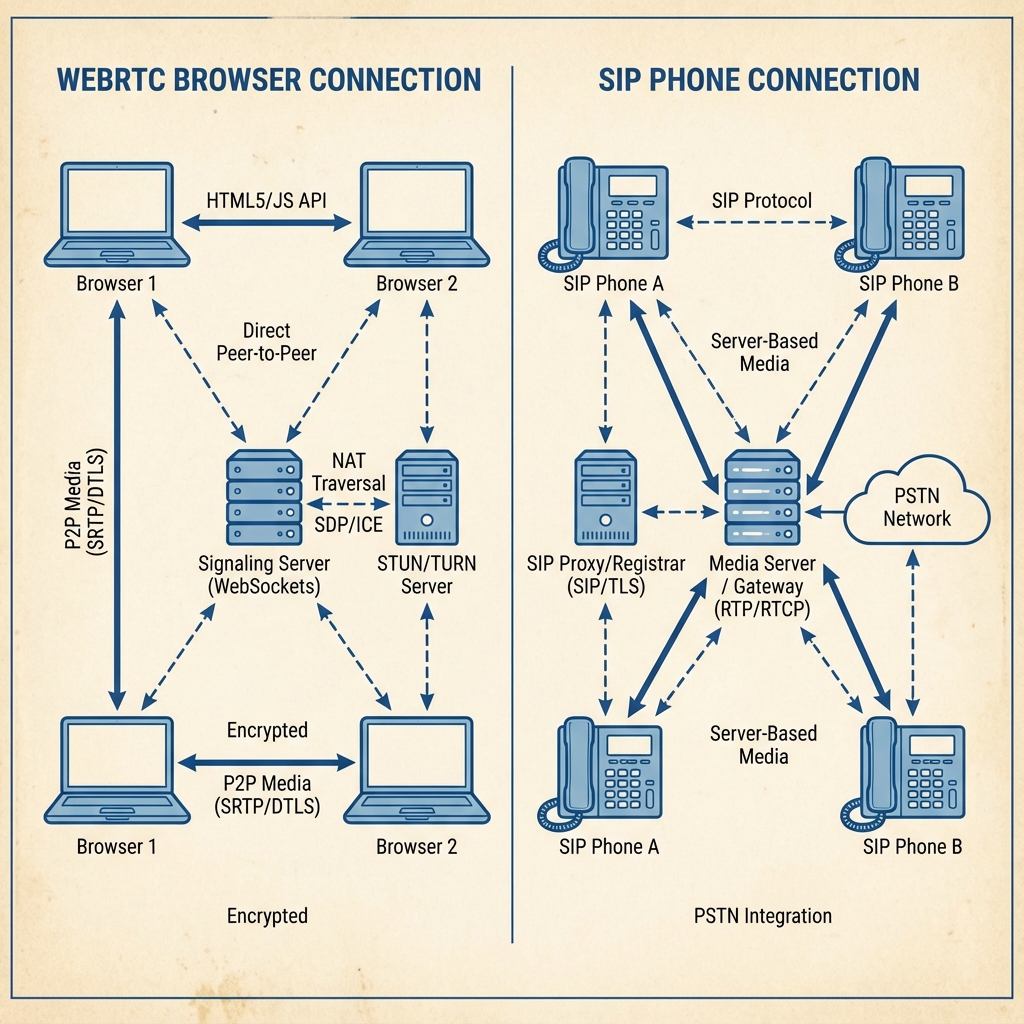
The Convergence
Modern VoIP architectures use a WebRTC Gateway (like Janus or a module in FreeSWITCH). The browser talks WebRTC to the gateway, and the gateway talks standard SIP/RTP to the legacy carrier network.
This allows a user on a Chrome browser to call a landline in Germany. The browser doesn't know about the landline; it just sees a peer connection to the gateway.
Verdict
Use WebRTC for client-side browser apps. Use SIP for the backend core and carrier interconnects.